
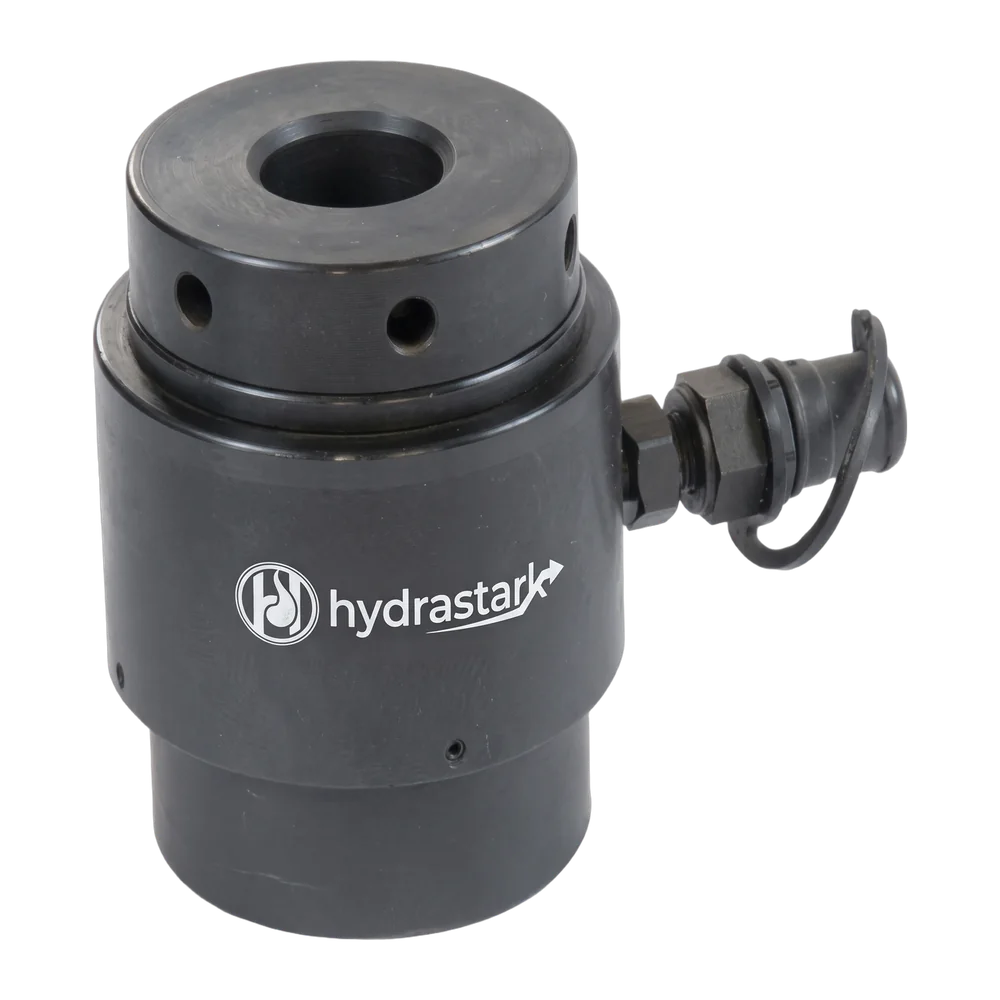
Torquing tightens a bolted joint by rotating the nut under 700 Bar (10,000 PSI) hydraulic force; up to 90% of input energy is consumed by thread and nut-face friction, making it fast and versatile for general flanges with minimal stud protrusion. Bolt tensioning stretches the stud axially using 1,500 Bar (21,750 PSI) hydraulic pressure before running the nut down by hand with zero friction—eliminating torsional shear stress and achieving ±3% residual preload accuracy on critical high-pressure joints.
1. What Is Torquing? Definition & Rotational Mechanics
Torquing is the method of applying rotational force (moment of force, measured in N·m or ft-lbs) to turn a nut or bolt head along the helical inclined plane of the fastener threads. As the nut advances against the joint surface, the stud stretches and generates clamping preload.
In heavy industrial bolting—where fastener diameters exceed M24 (1")—manual torque wrenches cannot generate sufficient rotational moment. Engineers deploy 700 Bar (10,000 PSI) hydraulic torque wrenches driven by two-stage or three-stage hydraulic power packs:
- Square Drive Hydraulic Torque Wrenches (HSW Series): Deliver 112 to 72,000 N·m (82 to 53,280 ft-lbs) across 3/4", 1", 1-1/2", and 2-1/2" square drives using heavy-duty HS-SKT impact sockets (22 to 180 mm hex sizes).
- Low-Profile Hollow Hexagon Wrenches (HHW & HHW-S Series): Fit directly over nuts from 19 to 175 mm across flats, delivering 228 to 44,593 N·m with a 35–95 mm slim cylinder profile for tight flange-to-pipe clearances.
- Ring & Open-End Spanner Wrenches (HHW-R Series): Deliver 346 to 18,165 N·m across S19 to S120 mm for radial side-slip access on severely obstructed pipe racks.
The 90% Friction Limitation in Torquing: Even when a hydraulic torque wrench is calibrated to ±3% tool torque accuracy, the resulting axial bolt preload follows the empirical relationship T = K × D × F. Approximately 50% of applied torque is lost overcoming nut-face friction against the washer/flange, and 40% is lost to thread flank friction. Only ~10% of input torque converts into net axial clamping force—meaning variations in thread lubrication, surface galling, or temperature can induce ±15% to ±30% scatter in actual clamping load.
2. What Is Bolt Tensioning? Definition & 1,500 Bar Pure Axial Stretch
Tensioning (specifically hydraulic bolt tensioning) is the direct axial elongation of a stud bolt using an annular hydraulic jack prior to seating the nut. Instead of rotating the nut under load, a hydraulic bolt tensioner pulls the bolt straight up along its centerline at 1,500 Bar (150 MPa / 21,750 PSI).
- Bridge & Puller Mounting: A slotted support bridge is placed over the existing hex nut against the flange face, and a threaded puller sleeve screws onto the protruding stud threads above the nut.
- 1,500 Bar Axial Elongation: A dedicated HTP-E electric or HTP-A pneumatic 1,500–3,000 Bar pump pressurizes the tensioner cylinder, stretching the stud axially within its elastic limit and lifting the nut slightly off the flange face.
- Zero-Friction Nut Run-Down: Because the hydraulic tensioner carries 100% of the tensile load, the operator uses a simple tommy bar inserted through the bridge window to turn the unloaded nut down snugly against the flange face.
- Pressure Release & Load Transfer: When hydraulic pressure is vented to zero, the stretched stud attempts to contract, transferring pure axial clamping force into the nut and gasket with zero torsional shear stress and zero thread galling.
HydraStark manufactures three distinct 1,500 Bar axial tensioning architectures for different clearance envelopes:
- Single-Stage Topside Bolt Tensioners (HST-S Series): Deliver 282 to 3,216 kN (28.7 to 328 metric tons) across M24 to M100 studs with interchangeable threaded pullers and twin daisy-chain couplers for ASME B16.5/B16.47 pressure vessels and heat exchangers.
- Multi-Stage Compact Bolt Tensioners (HST-M Series): Use coaxial stacked pistons at 1,500 Bar to achieve high tensile loads within a narrow outer diameter—essential for wind turbine tower rings, nacelle yaw bearings, and steam turbine casings.
- Mechanical Lock-Ring Hydraulic Nuts (HHN-L Series): Replace the standard hex nut permanently on M27 to M125 studs, delivering 226 to 3,864 kN at 1,500 Bar and locking the preload mechanically via an integral knurled collar.
3. Engineering Comparison Matrix: Hydraulic Torque Wrench vs. Bolt Tensioner
Use the engineering matrix below to evaluate whether a 700 Bar hydraulic torque wrench or a 1,500 Bar hydraulic bolt tensioner fits your joint specification:
| Engineering Parameter | Hydraulic Torque Wrench (Torquing) | Hydraulic Bolt Tensioner (Tensioning) |
|---|---|---|
| Rated Working Pressure | 700 Bar (10,000 PSI / 70 MPa) | 1,500 Bar (21,750 PSI / 150 MPa) |
| Load Application Principle | Rotational torque applied to nut faces | Direct pure axial elongation of stud threads |
| Frictional Energy Loss | ~85% to 90% lost to thread & nut-face friction | 0% rotational friction (compensated for elastic seating relaxation) |
| Residual Preload Accuracy | ±15% to ±30% clamping force scatter (lubrication dependent) | ±3% to ±5% net axial clamping preload uniformity |
| Torsional Stress & Galling | Induces torsional shear stress; risk of stainless/alloy thread galling | Zero torsional stress; completely prevents thread galling |
| Stud Stick-Out Requirement | None (works on flush studs and cap screws) | Requires minimum 1.0 × Bolt Diameter (1D) protruding above nut |
| Overhead vs. Radial Clearance | Low overhead height (especially HHW / HHW-S); needs reaction point | Needs vertical head clearance for puller/bridge; compact radial footprint (HST-M) |
| Simultaneous Multi-Bolt Tightening | 2 or 4 wrenches simultaneously via HTW-P4E / HTW-P3S pump | 25%, 50%, or 100% of flange studs daisy-chained simultaneously |
| HydraStark Series Coverage | HSW (112–72,000 N·m), HHW / HHW-S (228–44,593 N·m), HHW-R (346–18,165 N·m) | HST-S (282–3,216 kN, M24–M100), HST-M (Multi-Stage), HHN-L (226–3,864 kN) |
4. Four Field Decision Rules: When to Use Torquing vs. Tensioning
During refinery turnarounds, wind farm erection, and offshore subsea commissioning, joint geometry and service severity dictate tool selection:
- Rule 1 — Check Stud Protrusion First: If the existing bolts are hex-head cap screws or studs cut flush with the top of the nut, a bolt tensioner cannot engage. You must use a hydraulic torque wrench (or replace the studs with longer rods having at least
1 × Diameterextra thread length above the nut). - Rule 2 — Bolt Diameter & Preload Threshold (M36 / 1-1/2" Crossover): On studs up to M36 (1-1/2"), hydraulic torque wrenches offer rapid setup and flexible socket sizing. Above M36—and especially on M48 to M100+ high-tensile studs—nut-face friction under extreme surface pressure causes erratic torque-preload scatter and severe galling, making 1,500 Bar hydraulic bolt tensioners the mandatory engineering choice.
- Rule 3 — Gasket Crush & ASME PCC-1 Flange Uniformity: High-pressure heat exchangers, hydrogen reactors, and ring-type joint (RTJ) flanges are highly sensitive to uneven gasket compression. Connecting HST-S tensioners to 50% or 100% of the studs simultaneously compresses the gasket evenly in one or two passes without flange rotation or cocking.
- Rule 4 — Seized or Corroded Disassembly: While tensioners excel at precision assembly and controlled detensioning of healthy threads, heavily corroded refinery flange nuts with ruined outer threads cannot accept a tensioner puller. For corroded breakouts, pair a high-output HSW square drive torque wrench with a 700 Bar HNS or HNC hydraulic nut splitter.
5. Frequently Asked Questions (FAQ): Torquing vs. Tensioning
What is the main difference between torquing and tensioning?
Torquing rotates the nut under load at 700 Bar to stretch the bolt indirectly through thread inclination, losing roughly 85–90% of input energy to friction. Tensioning pulls the stud axially at 1,500 Bar before the nut is spun down by hand with zero friction, eliminating torsional shear stress and delivering ±3% preload accuracy.
At what bolt size should you switch from a hydraulic torque wrench to a bolt tensioner?
While both tools overlap between M24 and M48 (1" to 1-7/8"), engineering specifications typically transition from hydraulic torque wrenches to 1,500 Bar hydraulic bolt tensioners at M36 (1-1/2") and above, or on any critical joint where thread galling, torsional wind-up, or uneven gasket seating cannot be tolerated.
How much stud protrusion is required for a hydraulic bolt tensioner?
A topside hydraulic bolt tensioner (such as the HydraStark HST-S or HST-M Series) requires at least 1.0 × Bolt Diameter (1D) of clean, undamaged thread protruding above the top face of the nut so the threaded puller sleeve can safely sustain 1,500 Bar tensile load without stripping.
Why do hydraulic bolt tensioners operate at 1,500 Bar while torque wrenches use 700 Bar?
A bolt tensioner must sit directly over the bolt circle where radial spacing between adjacent nuts is tightly restricted by flange standards (ASME B16.5 / B16.47). Operating at 1,500 Bar (21,750 PSI) allows a compact annular piston area to generate up to 3,216 kN of direct axial stretch without colliding with neighboring studs.
Explore HydraStark Controlled Bolting Systems
All HydraStark 700 Bar torque wrenches and 1,500 Bar bolt tensioners are factory load-tested at 125% of rated working pressure: