
Petrochemical refinery turnarounds (TAR) operate under aggressive maintenance timelines where hundreds of high-temperature, high-pressure pipe flanges must be inspected, re-gasketed, and recommissioned. Uncontrolled flange leaks during startup—especially on catalytic cracking, hydroprocessing, and alkylation units—trigger hazardous volatile organic compound (VOC) emissions, costly unplanned shutdowns, and catastrophic fire hazards. Achieving a verifiable zero-leakage startup requires systematic flange integrity control.
1. The Root Causes of Flange Leaks Post-Turnaround
Field post-mortem analysis shows that over 80% of flange joint failures are not caused by defective spiral-wound gaskets, but rather by improper bolting assembly practices:
- Gasket Crushing via Non-Uniform Loading: Tightening bolts in a simple circular sequence pinches the gasket on one side while unloading the opposite quadrant, breaking the sealing bead.
- Insufficient Residual Gasket Stress: Failing to overcome flange misalignment and thermal creep during hydrostatic proof testing.
- Hot-Torch Nut Removal Damage: Utilizing oxy-acetylene cutting torches to burn seized nuts creates localized thermal deformation on flange faces and stud holes, requiring extensive on-site re-machining.
HydraStark mandates strict alignment with ASME PCC-1-2022 Guidelines for Pressure Boundary Bolted Flange Joint Assembly. By utilizing calibrated 700 Bar hydraulic torque wrenches (square drive or low-profile direct-fit cassettes), torque output repeatability is maintained within ±3%.
2. Non-Sparking Hydraulic Nut Splitting for Corroded Studs
In hydrodesulfurization and sour-gas units, B7/2H alloy steel studs frequently suffer severe sulfide stress corrosion and thread seizure. Conventional striking wrenches or impact guns generate hot sparks (prohibited in Class I, Div 1 ATEX zones) and induce severe vibration that can damage adjacent ceramic pipe linings.
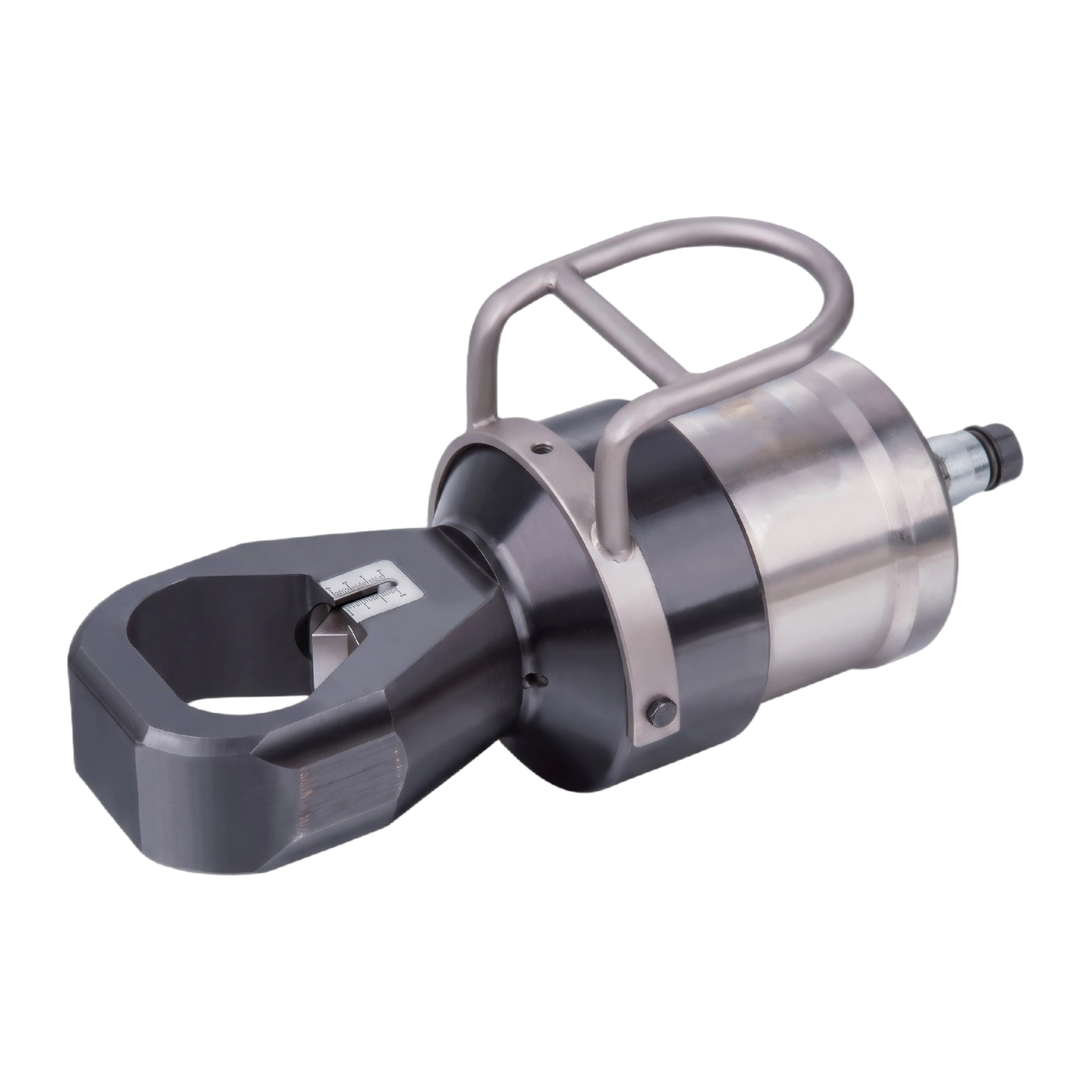
Deploying heavy-duty hydraulic nut cutters (HydraStark HNC Series) delivers up to 100 Tons of concentrated wedge force through calibrated heavy-duty tool steel blades. Seized nuts are sliced along their axial plane in under 45 seconds without flying debris, zero sparks, and zero damage to the stud bolt threads, slashing turnaround schedule bottlenecks by over 60%.
3. The 4-Stage Star-Pattern Torquing Sequence
To ensure uniform compressive seating on corrugated metal or graphite-filled gaskets, hydraulic torque must be applied in a crisscross diagonal pattern according to the following 4 stages:
| Pass Stage | Target Torque % | Tightening Sequence | Engineering Objective |
|---|---|---|---|
| Pass 1 | 20% - 30% | Cross-Star Pattern | Parallel flange alignment; eliminates gap angle |
| Pass 2 | 50% - 70% | Cross-Star Pattern | Uniform partial gasket compression |
| Pass 3 | 100% Target Torque | Cross-Star Pattern | Full target design bolt clamp stress |
| Pass 4 (Final) | 100% Target Torque | Clockwise Rotational Pass | Compensates for adjacent bolt relaxation; ensures zero loose nuts |
4. Recommended Bolting & Maintenance Equipment
HydraStark equips global EPC turnaround contractors with hydraulic torque tooling and pipeline maintenance accessories:
Featured Flange Maintenance Equipment
Explore high-speed hydraulic nut cutters, low-profile wrenches, and flange spreaders: