Offshore wind turbine generators (8 MW to 16 MW class) are subjected to extreme cyclic aerodynamic fatigue, wave-induced hydrodynamic bending moments, and severe marine salt-spray corrosion. Within these colossal structures, the bolted L-flange connections of the tubular tower sections and the anchor cage foundation ring represent the most critical structural load paths. Ensuring exact, uniform residual bolt preload is the single decisive factor in preventing catastrophic bolt fatigue failure and flange separation.
1. The Mechanical Failure Mechanism of Conventional Torquing in Offshore Towers
In standard structural fabrication, torquing methods rely on rotational force transferred through nut thread helixes. Under field conditions on offshore installation vessels (WTIVs), thread lubrication dispersion, surface roughness, and salt mist oxidation cause friction coefficients (μ) to vary unpredictably between 0.08 and 0.22. Consequently, up to 90% of applied torque is dissipated as parasitic friction, leaving residual clamp load accuracy drifting beyond ±30%.
Furthermore, torsional shear stress induced during torquing remains locked within the stud shank. When superimposed onto cyclic offshore wave and gust moments, this residual torsion significantly reduces the fatigue limit of high-strength Class 10.9 and 12.9 foundation studs (M36 to M72), precipitating premature micro-crack propagation.
Unlike torque wrenches, 1500 Bar hydraulic bolt tensioners exert 100% pure axial elongation directly onto the stud bolt protrusion. The nut is rotated down finger-tight against the flange face with zero thread friction or torsional wind-up. When hydraulic pressure releases, residual preload accuracy is governed within a tight ±3% tolerance band.
2. 50% vs. 100% Synchronous Daisy-Chain Tensioning Topology
Modern wind turbine tower flanges typically feature 80 to 140 bolts per circumferential joint. Single-tool tightening introduces localized flange deflection, known as elastic cross-talk or bolt relaxation. To eliminate uneven load distribution, two synchronous tensioning protocols are deployed:
| Tensioning Configuration | Tooling Ratio | Passes Required | Bolt Relaxation Risk | Field Efficiency |
|---|---|---|---|---|
| 100% Simultaneous Tensioning | 1 tensioner per bolt (full ring) | 1 Single Pass | 0% (Zero Elastic Cross-Talk) | Fastest installation; high vessel crane productivity |
| 50% Daisy-Chain (Segmental) | 1 tensioner every alternate bolt | 2 Passes (Pass 1 @ 105%, Pass 2 @ 100%) | < 4% compensated via overpull | Optimal tooling investment balance for foundation cages |
3. Standard 4-Step Standard Operating Procedure (1500 Bar)
- Protrusion Verification & Nut Thread Engagement: Confirm that the stud bolt protrusion above the hex nut is at least 1.0x to 1.2x the stud nominal diameter (d) to guarantee full puller sleeve thread engagement.
- Synchronous Link Coupling: Connect up to 16 to 32 tensioners in parallel via ultra-high-pressure flexible hoses rated for 1800 Bar burst protection, utilizing quick-connect CEJN-compatible quick couplers.
- Calculated Overpull Pressurization: Utilizing a 1500 Bar calibrated electric/pneumatic power pack (such as the HydraStark HPT-1500), pressurize the circuit to calculated load A (accounting for mechanical transfer loss / thread settling factor).
- Nut Snug Down & De-energization: Engage the tommy bar through the tensioner window to turn the nut firmly down onto the flange seat. Open the hydraulic release valve, allowing the load to transfer purely in tension to the tightened nut.
4. Recommended Tooling Package for Wind Turbine Bolting
To execute offshore foundation and tower bolting with zero downtime, HydraStark provides factory-calibrated 1500 Bar tensioning tooling engineered specifically for tight clearance L-flanges:
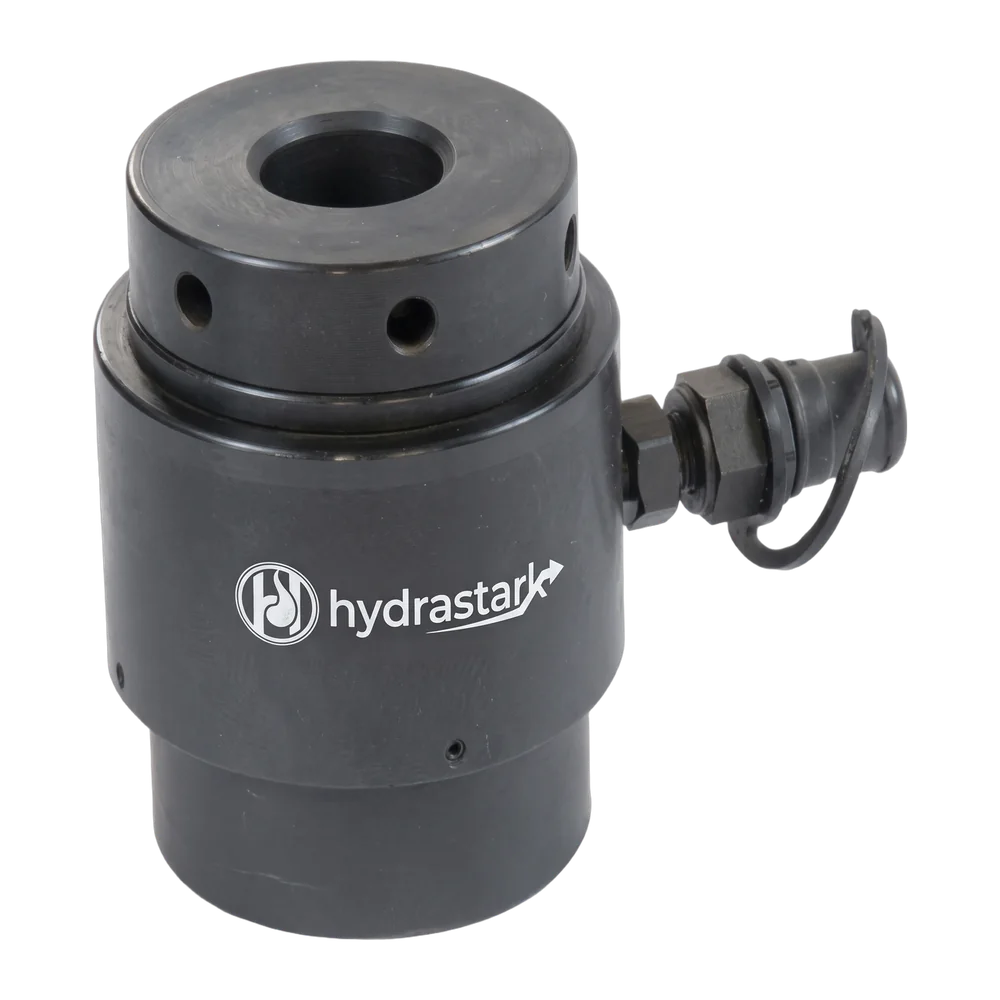
Recommended Hydraulic Tensioning Solutions
Explore HydraStark's precision 1500 Bar tooling, complete with dimensional blueprints and global shipping logistics: