
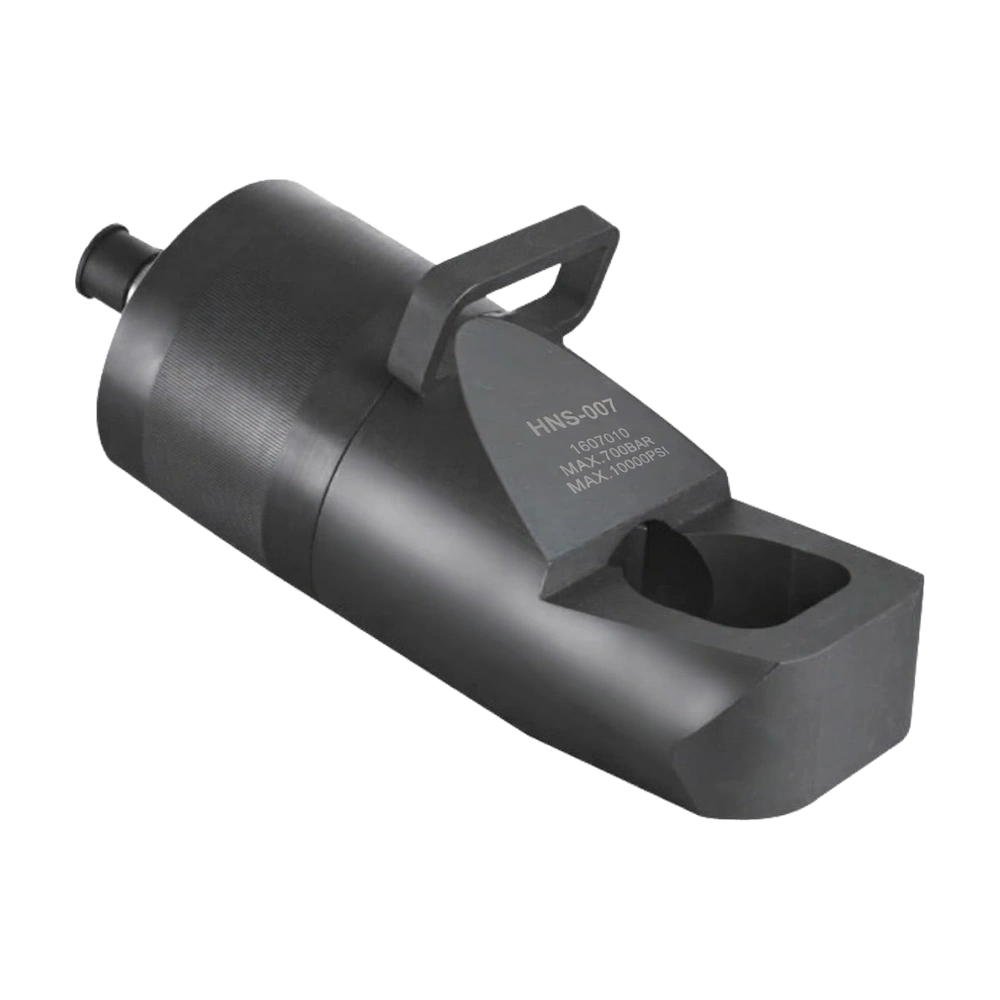
When ASTM A194 2H heavy hex nuts seize onto studs due to high-temperature oxidation, subsea corrosion, or thread galling, oxy-acetylene torch cutting introduces open-flame explosion hazards, requires costly hot-work permits, and frequently gouges the underlying stud threads or flange face. A 700 Bar (10,000 PSI) hydraulic nut splitter drives a hardened alloy-steel chisel into the nut wall in a spark-free cold-work cycle—fracturing M8 to M90 nuts in seconds while preserving 100% of the stud threads.
1. Why Flange Nuts Seize & Why Torch Cutting Fails in Classified Zones
In refinery turnarounds, subsea pipelines, and chemical heat exchangers, bolted joints undergo thermal cycling, chloride exposure, and high contact stress. Over time, thread lubricant breaks down and microscopic metal transfer (galling) welds the nut threads to the stud.
Attempting to remove a seized nut with an oversized hydraulic torque wrench risks twisting the stud off below the flange surface. Traditional oxy-acetylene torch cutting or abrasive grinding creates four severe operational penalties:
- Hot-Work Permit Delays & Gas-Freeing Costs: In ATEX / Class I Div 1 hydrocarbon zones, open-flame cutting requires line purging, gas monitoring, fire watches, and multi-shift sign-offs.
- Stud Thread & Flange Face Gouging: Even skilled welders accidentally nick the stud root threads or heat-affected zone (HAZ) on the ASME flange face, forcing expensive in-situ flange machining.
- Toxic Fume Generation: Vaporizing PTFE-coated (Xylan), hot-dip galvanized, or cadmium-plated nuts releases hazardous fumes in confined vessel spaces.
- Unpredictable Slag Welds: Molten slag often re-solidifies inside the thread pitch, locking the nut fragment even tighter onto the bolt.
2. Cold-Work Mechanics: Angled Single-Blade (HNS) vs. Heavy-Duty Tri-Blade (HNC) Nut Splitters
A hydraulic nut splitter operates at 700 Bar (10,000 PSI) using a standard two-speed hand pump (HPM-S Series) or pneumatic pump (HPA Series). As hydraulic pressure builds, a heat-treated alloy-steel chisel advances into the flat of the hex nut until hoop tensile stress fractures the nut wall cleanly just before touching the bolt threads.
HydraStark engineers two distinct 700 Bar nut-splitting architectures based on fastener size and wall thickness:
- Compact Angled Hydraulic Nut Splitters (HNS Series): Cover hex nuts from 13 to 75 mm across flats (bolt sizes M8 to M48) with 5 to 90 metric tons of cutting force across 7 models (
HNS-001toHNS-007). The angled reaction head sits flat on the flange face with spring-assisted return. - Tri-Blade Heavy-Duty Flange Nut Cutters (HNC Series): Engineered for thick-walled large-diameter nuts from 70 to 130 mm across flats (bolt sizes M45 to M90) with 103 to 193 metric tons of cutting force across 6 models (
HNC-001toHNC-006) featuring indexable three-edge Tri-Blade cutting inserts.
3. Step-by-Step Cold-Cut Depth Calibration to Protect Stud Threads
To split a corroded hex nut without scratching the underlying stud threads, field technicians follow a four-step cold-cutting protocol:
- Step 1 — Measure Nut Across Flats (AF): Measure the hexagon flat-to-flat width in millimeters and select the matching HNS or HNC model whose AF range encompasses the nut.
- Step 2 — Position the Reaction Collar: Slide the closed splitter ring over the nut so the flat reaction back rests squarely against the opposite hex flat and the chisel blade aligns with the center of the target flat.
- Step 3 — Pressurize to Fracture Pop: Operate the 700 Bar pump until the chisel penetrates roughly 75–85% of the nut wall thickness, where tensile hoop stress cracks the remaining bridge with an audible pop—stopping immediately before contacting the bolt threads.
- Step 4 — Retract & Peel Off: Release pump pressure to retract the spring-return (HNS) or hydraulic-return (HNC) blade, rotate 180° if a ductile stainless nut requires a second cut, and lift the split nut halves off the undamaged stud.
4. Technical Selection Matrix: HydraStark 700 Bar HNS & HNC Hydraulic Nut Splitters vs. Hot-Work Torch Cutting
| Model / Method | Hex Nut Range (AF) | Bolt Thread Range | Cutting Force @ 700 Bar | Blade Geometry & Safety |
|---|---|---|---|---|
| HNS-001 / HNS-002 | 13–19 mm / 19–24 mm | M8–M12 / M12–M16 | 5 Ton (49 kN) / 10 Ton (98 kN) | Angled single blade; spark-free cold cut |
| HNS-003 / HNS-004 | 24–32 mm / 30–41 mm | M16–M22 / M20–M27 | 15 Ton (147 kN) / 20 Ton (196 kN) | Angled single blade; spring-assisted return |
| HNS-005 / HNS-006 | 41–50 mm / 50–60 mm | M27–M33 / M33–M39 | 35 Ton (343 kN) / 50 Ton (490 kN) | Angled single blade; heavy hex nut splitting |
| HNS-007 | 60–75 mm | M39–M48 | 90 Ton (882 kN) | Angled single blade; refinery turnaround service |
| HNC-001 / HNC-002 / HNC-003 | 70–85 / 80–95 / 90–105 mm | M45–M56 / M52–M64 / M60–M72 | 103 Ton / 154 Ton | Indexable Tri-Blade heavy-duty flange nut cutter |
| HNC-004 / HNC-005 / HNC-006 | 100–115 / 110–130 mm | M64–M76 / M72–M90 | 154 Ton / 193 Ton (1,891 kN) | Indexable Tri-Blade cutter for offshore & subsea flanges |
| Oxy-Acetylene Torch | Any size | Any size | Thermal melting (~3,100 °C) | Open flame; hot-work permit required; damages stud threads |
Frequently Asked Questions (FAQ)
Can a hydraulic nut splitter cut stainless steel (A194 Grade 8) or Inconel nuts?
Yes. Because austenitic stainless steel (ASTM A194 Gr. 8 / 8M) has higher ductility than carbon steel 2H nuts, it stretches further before fracturing. On HNS single-blade splitters, make the first cut to 80% wall depth, rotate the tool 180 degrees to the opposite flat, and make a second cut. On HNC twin-blade splitters (103–193 Ton), both opposing blades cut simultaneously in a single cycle.
Will the hydraulic nut splitter chisel damage the stud bolt threads?
No, provided the operator stops pumping as soon as the nut wall fractures. The triple-bevel chisel geometry is designed to wedge the nut wall apart by tensile hoop stress when the blade tip is still 1.5–2.5 mm away from the minor thread diameter, leaving the stud ready for immediate re-bolting.
Which hydraulic pump is recommended for HNS and HNC nut splitters?
All HNS single-blade models (5–90 Ton) have single-acting spring-return cylinders (15 to 492 cm³ oil capacity) and pair directly with an HPM-S-700 or HPM-S-1000 700 Bar manual hand pump or HPA pneumatic pump. HNC twin-blade models (103–193 Ton) use double-acting cylinders and pair with a 700 Bar double-acting manual pump or HPE electric pump.